
PSMC3 (proteasome 26S subunit, ATPase 3)

The 26S proteasome is a multicatalytic proteinase complex with a highly ordered structure composed of 2 complexes, a 20S core and a 19S regulator. The 20S core is composed of 4 rings of 28 non-identical subunits; 2 rings are composed of 7 alpha subunits and 2 rings are composed of 7 beta subunits. The 19S regulator is composed of a base, which contains 6 ATPase subunits and 2 non-ATPase subunits, and a lid, which contains up to 10 non-ATPase subunits. Proteasomes are distributed throughout eukaryotic cells at a high concentration and cleave peptides in an ATP/ubiquitin-dependent process in a non-lysosomal pathway. An essential function of a modified proteasome, the immunoproteasome, is the processing of class I MHC peptides. This gene encodes one of the ATPase subunits, a member of the triple-A family of ATPases that have chaperone-like activity. This subunit may compete with PSMC2 for binding to the HIV tat protein to regulate the interaction between the viral protein and the transcription complex. A pseudogene has been identified on chromosome 9. [provided by RefSeq, Jul 2008]
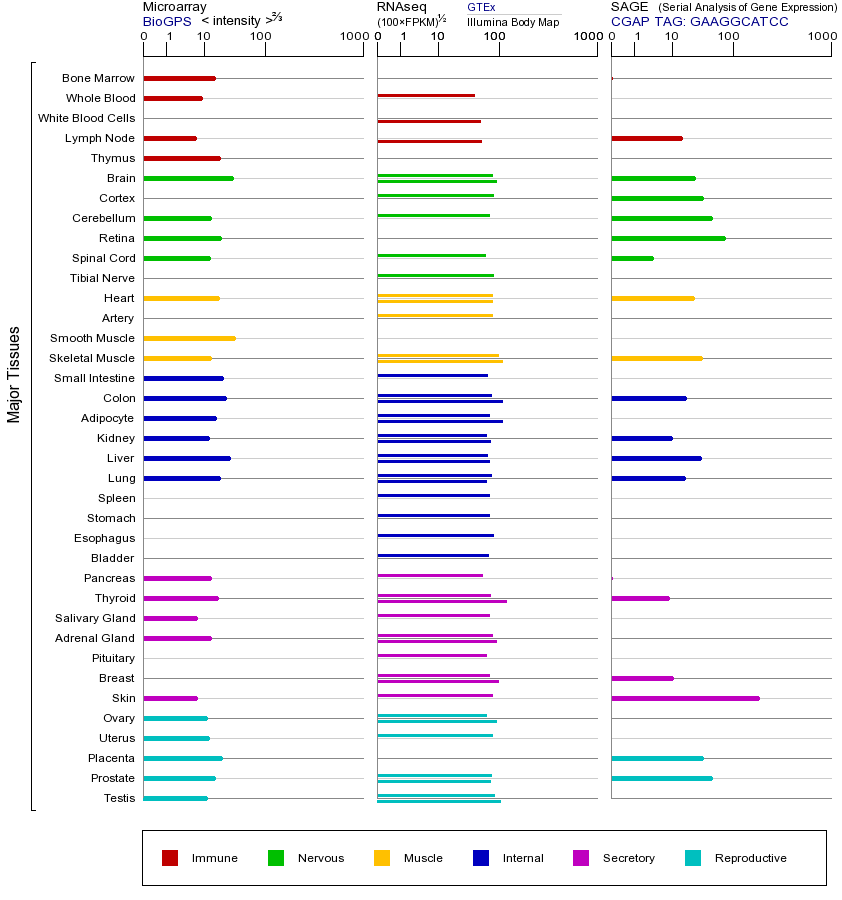
Gene Ontology
Subcellular localization of PSMC3 (and its protein):
- plasma membrane
- cytoplasm
- extracellular
- golgi
- vesicle
- cytoskeleton
- endoplasmic reticulum
- nucleus
- endosome
- lysosome
- mitochondrion
Gene Ontology (GO) terms for PSMC3:
| Interacting Gene | Interaction | Source/Score |
| Name |
|---|
| 3050 Proteasome [PATH:hsa03050] |
| 5169 Epstein-Barr virus infection [PATH:hsa05169] |
| Name |
|---|
| Activation of APC/C and APC/C:Cdc20 mediated degradation of mitotic proteins |
| Activation of NF-kappaB in B cells |
| Adaptive Immune System |
| Antigen processing-Cross presentation |
| Antigen processing: Ubiquitination & Proteasome degradation |
| APC:Cdc20 mediated degradation of cell cycle proteins prior to satisfation of the cell cycle checkpoint |
| APC/C-mediated degradation of cell cycle proteins |
| APC/C:Cdc20 mediated degradation of mitotic proteins |
| APC/C:Cdc20 mediated degradation of Securin |
| APC/C:Cdh1 mediated degradation of Cdc20 and other APC/C:Cdh1 targeted proteins in late mitosis/early G1 |
| Apoptosis |
| Assembly of the pre-replicative complex |
| Asymmetric localization of PCP proteins |
| AUF1 (hnRNP D0) destabilizes mRNA |
| Autodegradation of Cdh1 by Cdh1:APC/C |
| Autodegradation of the E3 ubiquitin ligase COP1 |
| beta-catenin independent WNT signaling |
| C-type lectin receptors (CLRs) |
| Cdc20:Phospho-APC/C mediated degradation of Cyclin A |
| CDK-mediated phosphorylation and removal of Cdc6 |
| CDT1 association with the CDC6:ORC:origin complex |
| Cell Cycle |
| Cell Cycle Checkpoints |
| Cell Cycle, Mitotic |
| Class I MHC mediated antigen processing & presentation |
| CLEC7A (Dectin-1) signaling |
| Cross-presentation of soluble exogenous antigens (endosomes) |
| Cyclin A:Cdk2-associated events at S phase entry |
| Cyclin E associated events during G1/S transition |
| Dectin-1 mediated noncanonical NF-kB signaling |
| degradation of AXIN |
| Degradation of beta-catenin by the destruction complex |
| degradation of DVL |
| Degradation of GLI1 by the proteasome |
| Degradation of GLI2 by the proteasome |
| Disease |
| Diseases of signal transduction |
| DNA Replication |
| DNA Replication Pre-Initiation |
| Downstream signaling events of B Cell Receptor (BCR) |
| ER-Phagosome pathway |
| G1/S DNA Damage Checkpoints |
| G1/S Transition |
| Gene Expression |
| GLI3 is processed to GLI3R by the proteasome |
| Hedgehog 'off' state |
| Hedgehog 'on' state |
| Hedgehog ligand biogenesis |
| Hh mutants abrogate ligand secretion |
| Hh mutants that don't undergo autocatalytic processing are degraded by ERAD |
| HIV Infection |
| Host Interactions of HIV factors |
| Immune System |
| Infectious disease |
| Innate Immune System |
| M Phase |
| M/G1 Transition |
| Metabolism of amino acids and derivatives |
| Mitotic Anaphase |
| Mitotic G1-G1/S phases |
| Mitotic Metaphase and Anaphase |
| Orc1 removal from chromatin |
| p53-Dependent G1 DNA Damage Response |
| p53-Dependent G1/S DNA damage checkpoint |
| p53-Independent DNA Damage Response |
| p53-Independent G1/S DNA damage checkpoint |
| PCP/CE pathway |
| Programmed Cell Death |
| Regulation of activated PAK-2p34 by proteasome mediated degradation |
| Regulation of APC/C activators between G1/S and early anaphase |
| Regulation of Apoptosis |
| Regulation of DNA replication |
| Regulation of mitotic cell cycle |
| Regulation of mRNA stability by proteins that bind AU-rich elements |
| Regulation of ornithine decarboxylase (ODC) |
| Removal of licensing factors from origins |
| S Phase |
| SCF-beta-TrCP mediated degradation of Emi1 |
| SCF(Skp2)-mediated degradation of p27/p21 |
| Separation of Sister Chromatids |
| Signaling by Hedgehog |
| Signaling by the B Cell Receptor (BCR) |
| Signaling by Wnt |
| Stabilization of p53 |
| Switching of origins to a post-replicative state |
| Synthesis of DNA |
| TCF dependent signaling in response to WNT |
| Ubiquitin Mediated Degradation of Phosphorylated Cdc25A |
| Ubiquitin-dependent degradation of Cyclin D |
| Ubiquitin-dependent degradation of Cyclin D1 |
| Vif-mediated degradation of APOBEC3G |
| Vpu mediated degradation of CD4 |
| Disease | Score | NofPmids | NofSnps | Source |
| HIV Infections | 0.120271442 | 2 | 0 | BeFree_CTD_human |
| Breast Carcinoma | 0.000271442 | 1 | 0 | BeFree |
| Malignant neoplasm of breast | 0.000271442 | 1 | 0 | BeFree |

Contact
No. 2 Wenbo Road, Zhangqiu District, Jinan, Shandong
Qilu Normal University · Genelibs Bioinformatics Lab
750 Shunhua Rd, Jinan
2F, Bldg F, University Science Park
Tel: 0531-88819269
WeChat Official Account
Follow our WeChat subscription account for real-time updates and the latest in medical and biological research.
Business Email
E-mail: product@genelibs.com

Copyright © 2026.Genelibs Jinan Honghui Biotechnology Co., Ltd. 鲁ICP备20007159号-2
