
WT1 (WT1 transcription factor)

symbol
WT1
locus group
protein-coding gene
location
11p13
gene_family
Zinc fingers, C2H2-type
alias symbol
WAGR|WIT-2|AWT1|NPHS4|WT-1
alias name
None
entrez id
7490
ensembl gene id
ENSG00000184937
ucsc gene id
uc001mtn.4
refseq accession
NM_000378
hgnc_id
HGNC:12796
approved reserved
1989-04-13
11p13
ChineseEnglish

Located on the short arm of human chromosome 11 (11p13), the Wilms Tumor 1 (WT1) gene encodes a critical zinc finger transcription factor that plays a pivotal role in embryonic development, particularly of the urogenital system, as well as in the regulation of cell proliferation and differentiation. The WT1 protein is characterized by the presence of four C2H2-type zinc finger domains, which facilitate sequence-specific DNA binding to modulate the transcription of target genes involved in growth factor signaling and apoptosis; notably, WT1 exhibits context-dependent dual functionality, acting as either an activator or repressor depending on the specific genomic locus and cellular environment. Its expression is highly restricted to key tissues, including renal glomerular podocytes, gonadal Sertoli and granulosa cells, and the hematopoietic system, where it is essential for maintaining structural integrity and functional differentiation. A unique feature distinguishing WT1 from other members of the early growth response (EGR) family is its extensive alternative splicing, which generates multiple isoforms—most notably the +KTS and -KTS variants—that differ in their DNA and RNA binding preferences, thereby expanding the complexity of its regulatory network. Mutations or alterations in WT1 expression are associated with a spectrum of severe phenotypes, including Denys-Drash syndrome (characterized by nephropathy, gonadal dysgenesis, and Wilms tumor) and Frasier syndrome (gonadal dysgenesis and nephrotic syndrome), as well as contributing to 10–20% of Wilms tumor cases, a pediatric renal malignancy where WT1 often functions as a tumor suppressor. Conversely, in the context of acute myeloid leukemia (AML), WT1 overexpression is frequently observed and is linked to poor prognosis, where it may act as an oncogene by disrupting normal hematopoietic differentiation and promoting leukemogenesis, thus illustrating the gene’s dual role as both a tumor suppressor and a proto-oncogene depending on tissue specificity and the nature of the molecular alteration.
Nucleotide sequence of WT1:[NCBI]
Loading Gene Browser...
Protein Sequence
1MGSDVRDLNA LLPAVPSLGG GGGCALPVSG AAQWAPVLDF
41APPGASAYGS LGGPAPPPAP PPPPPPPPHS FIKQEPSWGG
81 AEPHEEQCL SAFTVHFSGQ FTGTAGACRY GPFGPPPPSQ
121ASSGQARMFP NAPYLPSCLE SQPAIRNQGY STVTFDGTPS
161Y GHTPSHHA AQFPNHSFKH EDPMGQQGSL GEQQYSVPPP
201VYGCHTPTDS CTGSQALLLR TPYSSDNLYQ MTSQLECMTW
241NQ MNLGATL KGVAAGSSSS VKWTEGQSNH STGYESDNHT
281TPILCGAQYR IHTHGVFRGI QDVRRVPGVA PTLVRSASET
321SEK RPFMCA YPGCNKRYFK LSHLQMHSRK HTGEKPYQCD
361FKDCERRFSR SDQLKRHQRR HTGVKPFQCK TCQRKFSRSD
401HLKT HTRTH TGKTSEKPFS CRWPSCQKKF ARSDELVRHH
441NMHQRNMTKL QLAL
Structure predicted by AlphaFold DB(UniProt: P19544). Color indicates pLDDT confidence (dark blue = high, yellow/orange = low).
SNP variants of WT1:           Showing partial SNPs
rs1799925       rs2234579       rs2234580       rs2234581       rs2234582       rs2234583       rs2301250       rs2301251       rs2301252       rs2301253       rs2301254       rs3087461       rs3809060       rs3809061       rs3809062       rs3886325       rs3930513      

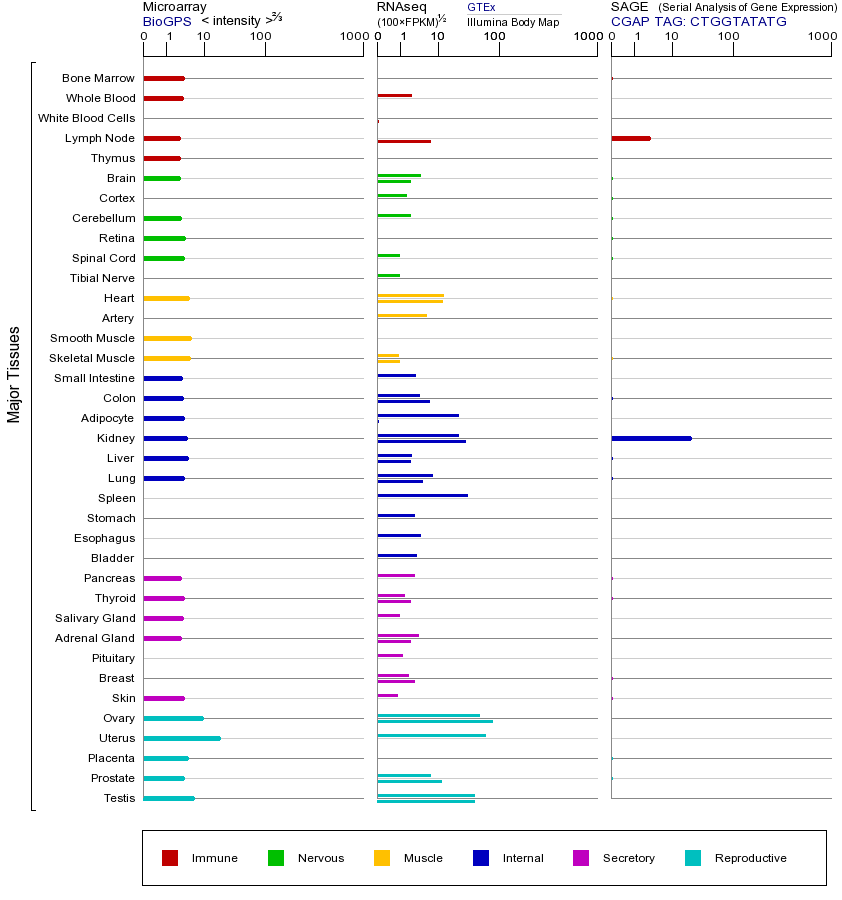
Tissue expression of WT1:    [UniProt]

Gene expression across tissues
Forward Primer
Forward Tm
Reverse Primer
Reverse Tm
Score
CCTACAGCAGTGACAATTTATACC
60
CATTTCACTGAGCTGGAGC
59
TCAGAGGCATTCAGGATGTG
60
TCTCTTATTGCAGCCTGGG
60
TCAGAGGCATTCAGGATGTG
60
CTCTTATTGCAGCCTGGGT
60
CCTACAGCAGTGACAATTTATACC
60
ATTTCACTGAGCTGGAGCT
59
CAGAGGCATTCAGGATGTG
58
CGTTTCTCACTGGTCTCAG
58
CCTACAGCAGTGACAATTTATACC
60
TTTCACTGAGCTGGAGCTC
60
Transcription Factors
Target Gene
Interaction Type
PubMed References
CTCF
WT1
Unknown
EP300
WT1
Activation
ETS1
WT1
Activation
GATA1
WT1
Activation
GATA1
WT1
Unknown
GATA2
WT1
Activation
HDAC4
WT1
Repression
HDAC5
WT1
Repression
HOXA10
WT1
Unknown
IFI16
WT1
Activation

Subcellular localization of WT1 (and its protein):

[UniProt]     [GenomeNet]

" d="M482.414,245.296c3.539,4.293,4.455,10.009,0.202,11 c-4.244,0.996-4.983-10.983-8.293-8.438c-5.271,4.08,9.834,12.271,5.144,17.287c-3.717,3.607-6.172-5.75-10.839-1.976 c-4.673,3.776,6.781,7.299,2.831,11.326c-4.354,4.045-6.979-1.449-9.837-5.517c-1.193-1.742-2.059-3.851-3.595-2.748 c-1.516,1.078-1.854,1.795-0.938,3.666c2.374,4.854,9.235,10.119,5.156,12.535c-5.636,3.346-5.044-8.871-9.426-7.574 c-4.388,1.291,2.557,10.66-1.245,11.141c-4.089,0.545-3.483-10.239-6.979-8.575c-2.522,1.206-0.929,3.071-0.938,4.899 c0.004,1.32-0.964,3.6-2.372,4.062c-3.593,1.171-8.544-1.065-10.251-3.59c-6.04-8.93,0.396-15.997,4.639-7.015 c3.023,4.642,5.182,0.834,2.839-2.219c-1.032-1.354-4.309-5.901-0.781-7.252c2.904-1.113,4.271,1.941,5.985,4.592 c2.61,4.016,5.485,0.117,3.031-3.414c-1.828-2.633-2.74-3.803,3.156-7.42c6.405-4.369,6.52,3.869,10.077,0.646 c2.309-1.832-4.783-5.149,0.06-8.995c2.896-2.293,5.18,6.207,7.961,3.516c3.523-2.737-7.717-7.369,0.117-11.736 C473.413,240.77,480.519,242.891,482.414,245.296z"/> Extracellular space Cytosol Plasma membrane Cytoskeleton Lysosome Endosome Peroxisome ER Golgi Apparatus Nucleus Mitochondrion 0 1 2 3 4 5 Confidence
  • plasma membrane
  • cytoplasm
  • extracellular
  • golgi
  • vesicle
  • cytoskeleton
  • endoplasmic reticulum
  • nucleus
  • endosome
  • lysosome
  • mitochondrion

Gene Ontology (GO) terms for WT1:

GO ID
Protein
Source DB
GO:0003676
A0A0A0MT54 (UniProtKB)
IEA
GO:0005634
A0A0A0MT54 (UniProtKB)
IEA
GO:0006355
A0A0A0MT54 (UniProtKB)
IEA
GO:0046872
A0A0A0MT54 (UniProtKB)
IEA
GO:0005634
E9PKS2 (UniProtKB)
IEA
GO:0006355
E9PKS2 (UniProtKB)
IEA
GO:0003676
E9PPW3 (UniProtKB)
IEA
GO:0046872
E9PPW3 (UniProtKB)
IEA
GO:0005634
H0Y3F0 (UniProtKB)
IEA
GO:0006355
H0Y3F0 (UniProtKB)
IEA
GO:0003676
H0Y7K5 (UniProtKB)
IEA
GO:0005634
H0Y7K5 (UniProtKB)
IEA
GO:0006355
H0Y7K5 (UniProtKB)
IEA
GO:0046872
H0Y7K5 (UniProtKB)
IEA
GO:0003676
H0YED9 (UniProtKB)
IEA
GO:0005634
H0YED9 (UniProtKB)
IEA
GO:0006355
H0YED9 (UniProtKB)
IEA
GO:0046872
H0YED9 (UniProtKB)
IEA
GO:0005634
J3KNN9 (UniProtKB)
IEA
GO:0043565
J3KNN9 (UniProtKB)
IEA
GO:0045944
J3KNN9 (UniProtKB)
IEA
GO:0046872
J3KNN9 (UniProtKB)
IEA
GO:0000122
P19544 (UniProtKB)
IDA
GO:0001077
P19544 (UniProtKB)
ISS
GO:0001570
P19544 (UniProtKB)
ISS
GO:0001657
P19544 (UniProtKB)
ISS
GO:0001658
P19544 (UniProtKB)
IGI
GO:0001822
P19544 (UniProtKB)
IGI
GO:0003156
P19544 (UniProtKB)
ISS
GO:0003700
P19544 (UniProtKB)
ISS
GO:0003700
P19544 (UniProtKB)
NAS
GO:0003700
P19544 (UniProtKB)
NAS
GO:0003723
P19544 (UniProtKB)
IEA
GO:0005515
P19544 (UniProtKB)
IPI
GO:0005515
P19544 (UniProtKB)
IPI
GO:0005515
P19544 (UniProtKB)
IPI
GO:0005515
P19544 (UniProtKB)
IPI
GO:0005515
P19544 (UniProtKB)
IPI
GO:0005515
P19544 (UniProtKB)
IPI
GO:0005515
P19544 (UniProtKB)
IPI
GO:0005515
P19544 (UniProtKB)
IPI
GO:0005634
P19544 (UniProtKB)
IDA
GO:0005634
P19544 (UniProtKB)
IDA
GO:0005634
P19544 (UniProtKB)
IDA
GO:0005634
P19544 (UniProtKB)
IDA
GO:0005634
P19544 (UniProtKB)
IDA
GO:0005634
P19544 (UniProtKB)
IDA
GO:0005654
P19544 (UniProtKB)
IDA
GO:0005730
P19544 (UniProtKB)
IEA
GO:0005737
P19544 (UniProtKB)
ISS
GO:0006355
P19544 (UniProtKB)
ISS
GO:0006355
P19544 (UniProtKB)
NAS
GO:0006355
P19544 (UniProtKB)
NAS
GO:0006357
P19544 (UniProtKB)
ISS
GO:0006366
P19544 (UniProtKB)
IEA
GO:0007281
P19544 (UniProtKB)
ISS
GO:0007356
P19544 (UniProtKB)
ISS
GO:0007507
P19544 (UniProtKB)
IGI
GO:0007530
P19544 (UniProtKB)
IDA
GO:0008270
P19544 (UniProtKB)
IDA
GO:0008285
P19544 (UniProtKB)
IDA
GO:0008285
P19544 (UniProtKB)
IDA
GO:0008380
P19544 (UniProtKB)
ISS
GO:0008406
P19544 (UniProtKB)
ISS
GO:0008584
P19544 (UniProtKB)
IEP
GO:0009888
P19544 (UniProtKB)
ISS
GO:0016607
P19544 (UniProtKB)
IDA
GO:0016607
P19544 (UniProtKB)
IDA
GO:0016607
P19544 (UniProtKB)
IDA
GO:0017148
P19544 (UniProtKB)
IDA
GO:0030308
P19544 (UniProtKB)
IDA
GO:0030308
P19544 (UniProtKB)
IDA
GO:0030308
P19544 (UniProtKB)
IDA
GO:0030325
P19544 (UniProtKB)
IGI
GO:0030539
P19544 (UniProtKB)
ISS
GO:0030855
P19544 (UniProtKB)
ISS
GO:0032835
P19544 (UniProtKB)
IGI
GO:0032836
P19544 (UniProtKB)
IMP
GO:0035802
P19544 (UniProtKB)
ISS
GO:0043010
P19544 (UniProtKB)
ISS
GO:0043065
P19544 (UniProtKB)
IDA
GO:0043066
P19544 (UniProtKB)
IGI
GO:0043565
P19544 (UniProtKB)
IDA
GO:0043565
P19544 (UniProtKB)
IDA
GO:0043565
P19544 (UniProtKB)
IDA
GO:0044212
P19544 (UniProtKB)
IDA
GO:0044212
P19544 (UniProtKB)
IDA
GO:0044212
P19544 (UniProtKB)
IDA
GO:0044212
P19544 (UniProtKB)
IDA
GO:0044212
P19544 (UniProtKB)
IDA
GO:0045892
P19544 (UniProtKB)
IDA
GO:0045892
P19544 (UniProtKB)
IDA
GO:0045892
P19544 (UniProtKB)
IDA
GO:0045892
P19544 (UniProtKB)
IDA
GO:0045892
P19544 (UniProtKB)
IDA
GO:0045892
P19544 (UniProtKB)
IDA
GO:0045892
P19544 (UniProtKB)
IDA
GO:0045892
P19544 (UniProtKB)
IDA
GO:0045892
P19544 (UniProtKB)
IDA
GO:0045892
P19544 (UniProtKB)
IDA
GO:0045892
P19544 (UniProtKB)
IDA
GO:0045892
P19544 (UniProtKB)
IDA
GO:0045893
P19544 (UniProtKB)
IGI
GO:0045893
P19544 (UniProtKB)
IDA
GO:0045893
P19544 (UniProtKB)
IDA
GO:0045893
P19544 (UniProtKB)
IDA
GO:0045893
P19544 (UniProtKB)
IDA
GO:0045893
P19544 (UniProtKB)
IDA
GO:0045893
P19544 (UniProtKB)
IDA
GO:0045893
P19544 (UniProtKB)
IDA
GO:0045893
P19544 (UniProtKB)
IDA
GO:0045893
P19544 (UniProtKB)
IDA
GO:0045893
P19544 (UniProtKB)
IDA
GO:0045893
P19544 (UniProtKB)
IDA
GO:0045944
P19544 (UniProtKB)
IEA
GO:0060231
P19544 (UniProtKB)
ISS
GO:0060421
P19544 (UniProtKB)
ISS
GO:0060539
P19544 (UniProtKB)
ISS
GO:0060923
P19544 (UniProtKB)
ISS
GO:0061032
P19544 (UniProtKB)
IGI
GO:0070742
P19544 (UniProtKB)
IPI
GO:0071320
P19544 (UniProtKB)
IEP
GO:0071371
P19544 (UniProtKB)
IDA
GO:0072075
P19544 (UniProtKB)
ISS
GO:0072112
P19544 (UniProtKB)
ISS
GO:0072166
P19544 (UniProtKB)
ISS
GO:0072207
P19544 (UniProtKB)
IEP
GO:0072284
P19544 (UniProtKB)
IGI
GO:0072302
P19544 (UniProtKB)
ISS
GO:2000020
P19544 (UniProtKB)
ISS
GO:2000195
P19544 (UniProtKB)
ISS
GO:2001076
P19544 (UniProtKB)
ISS
GO:0045893
P19544 (UniProtKB)
IDA
GO:0045893
P19544 (UniProtKB)
IDA

microRNAs potentially regulating WT1:     

String
BioGrid
IntAct
mentha
MINT
Loading…
Interacting Gene Interaction Source/Score
Disease Score NofPmids NofSnps Source
Denys-Drash Syndrome 0.572691755 43 11 BeFree_CLINVAR_CTD_human_GAD_LHGDN_MGD_ORPHANET_UNIPROT
Frasier Syndrome 0.487610304 19 5 BeFree_CLINVAR_CTD_human_LHGDN_ORPHANET_UNIPROT
Nephroblastoma 0.444098287 220 2 BeFree_CTD_human_GAD_LHGDN_ORPHANET_UNIPROT
MEACHAM SYNDROME (disorder) 0.36 2 2 CLINVAR_ORPHANET_UNIPROT
WAGR Syndrome 0.246167218 14 0 BeFree_CTD_human_GAD_ORPHANET
NEPHROTIC SYNDROME, TYPE 4 0.24 4 0 CTD_human_UNIPROT
Leukemia, Myelocytic, Acute 0.174303151 62 1 BeFree_CTD_human_GAD_LHGDN
leukemia 0.142840843 49 1 BeFree_CTD_human_LHGDN
Mammary Neoplasms 0.142337686 10 0 BeFree_CTD_human_LHGDN
Desmoplastic Small Round Cell Tumor 0.130314791 38 0 BeFree_ORPHANET
Clinical Presentation, Genetic Testing, and Outcome of Congenital Nephrotic Syndrome in KwaZulu-Natal, South Africa.
Bhimma R, Winkler CA, Nandlal L, David V, Cho S, Naicker T Nephron IF: 2.3 2025-10-16
A Giant Adenomatoid Tumor of the Adrenal Gland: A Report of a Rare and Interesting Case.
Bayar I, Aissaoui T, Bellalah A, Tabka MH, Hanene S Cureus 2026-08-00
Biomarker-driven neoadjuvant immunotherapy in triple-negative breast cancer: emerging therapeutic targets FOXP3 and WT1.
Zhang Z, Zhao R, Hu Y, Xie Q, Yu Y, Li K, Ding Z, Wang M Front Immunol IF: 7.0 None
Regulated HSPG Signaling Directs Epicardial Behavior to Support Cardiac Formation.
Redpath AN, Lupu IE, Haffreingue L, Dang QM, McCracken IR, Carsana T, van Kuppevelt TH, Vieira JM, Smart N Circ Res IF: 18.0 2026-08-25
Distinct mutational landscapes for germline and somatic cancer variants in forty tumor suppressor genes.
Lulla SD, Ritter DI, Kesserwan C, Plon SE Am J Hum Genet IF: 7.7 2026-08-25
Wt1 Is Required for the Regression of Müllerian Ducts in Male Mice by Inducing Wif1 and Osx Expression.
Chen M, Qi X, Qin S, Kang J, Cen C, Guo M, Gao Y, Wang M, Li J, Cui X, Wang Y, Zhu L, Gao F Cell Prolif IF: 7.6 2026-07-14
Age-dependent clinical, molecular, and prognostic differences in patients with AML: a retrospective study.
Liu H, Li Z, Ma J, Shi Y, Tao S, Chen Y, Ji T, Su Y, Chen Q, Wang C, Yu L Hematology IF: 2.0 2026-12-00
T-cell receptor clonotypic diversity and specialization in digestive system cancers.
Li L, Li J, Wang F, Jiang R, Wang H, Li X, Zhen Y NPJ Precis Oncol 2026-01-28
Wilms Tumor 1-Expressing Stromal Cells Promote Pancreatic Cancer Progression.
Bischoff AC, Brown K, Lasse Opsahl EL, Watkoske HR, Espinoza CE, Okoye JO, Olivei AC, Green LM, Rai R, The S, Yan W, denDekker AD, Carpenter ES, Shi J, Bednar F, Frankel TL, Zhang Y, Pasca di Magliano M Cancer Res IF: 22.6 2026-01-16

Loading comments...

Log in to post comments Log In Sign Up

Contact

No. 2 Wenbo Road, Zhangqiu District, Jinan, Shandong

Qilu Normal University · Genelibs Bioinformatics Lab

750 Shunhua Rd, Jinan

2F, Bldg F, University Science Park

Tel: 0531-88819269

WeChat Official Account

Follow our WeChat subscription account for real-time updates and the latest in medical and biological research.


Business Email

E-mail: product@genelibs.com

